

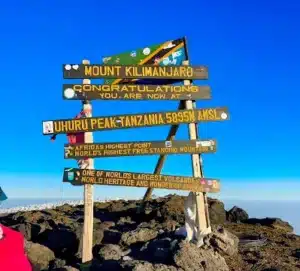
Standing at 5,895 meters (19,341 feet), Mount Kilimanjaro is Africa’s tallest peak and one of the world’s most sought-after trekking destinations. Unlike technical climbs like Everest, Kilimanjaro is a non-technical trek, making it accessible to determined adventurers with proper preparation. Over 50,000 trekkers attempt the summit annually, yet only 65% successfully reach Uhuru Peak—primarily due to altitude challenges.
History and Geography
Mount Kilimanjaro is located in Tanzania, Africa. It’s actually a dormant volcano with three distinct cones: Kibo, Mawenzi, and Shira. The mountain is part of Kilimanjaro National Park, which is not only a UNESCO World Heritage site but also home to diverse wildlife and plant species.
🏔️ Mount Kilimanjaro Trek Overview

🌍 Complete Trek Overview
Mount Kilimanjaro, located in Tanzania, stands as a beacon for trekkers worldwide. Unlike treks in Kashmir or Uttarakhand, Kilimanjaro’s unique draw lies in its accessibility—no technical climbing skills are required, yet it offers high-altitude challenges. The trek traverses five distinct ecological zones, offering unparalleled biodiversity. Super Trekkers’ guided services enhance the experience with expert guides trained in altitude safety and local culture.
Kilimanjaro is moderately challenging. Expect 5-8 hours of daily hiking, with the summit day pushing 12-14 hours. A baseline fitness level of 10-12 km daily walking and stair-climbing endurance is recommended. Super Trekkers offers pre-trek fitness consultations to ensure readiness.
- First-time trekkers (with 3+ months training)
- Adventure travelers seeking a non-technical high-altitude challenge
- Nature lovers wanting diverse landscapes
- Bucket-list achievers (one of the Seven Summits)


⚖️ Kilimanjaro vs. Similar Treks
How does Mount Kilimanjaro stack up against other world-class treks? While Everest Base Camp and Annapurna are iconic Himalayan journeys, Kilimanjaro offers a unique “summit” experience in Africa.
| Trek | Difficulty | Max Altitude | Duration | Best For |
|---|---|---|---|---|
| 🏔️ Mt. Kilimanjaro | Moderate | 5,895m (19,341 ft) | 5-9 days | Scenic diversity & Summit achievement |
| Everest Base Camp | Moderate | 5,364m (17,598 ft) | 12-14 days | Himalayan culture & Iconic views |
| Annapurna Circuit | Challenging | 5,416m (17,769 ft) | 15-21 days | Varied terrain & Long-distance trekking |

📅 Best Time to Visit Kilimanjaro
The optimal windows are January-March and June-October, balancing dry weather and clear summit views. Avoid April-May due to heavy rains.
| Month | Weather | Pros | Cons |
|---|---|---|---|
| Jan-Mar | Dry, warm | Clear skies, high summit success | Crowded trails, Cold Nights |
| Jun-Oct | Dry, cooler | Fewer crowds, stable weather | Cold nights at high altitudes |
| Apr-May | Heavy rain | Low crowds, lush scenery | Heavy rains, muddy trails |
| Nov-Dec | Short rains | Quieter trails, lower cost | Unpredictable weather |
🗺️ Best Routes to Kilimanjaro Peak
There are seven established routes for climbing Mount Kilimanjaro: Lemosho, Machame, Marangu, Rongai, Northern Circuit, Umbwe, and Shira. Each route offers a unique experience with varying scenery, difficulty levels, and acclimatization opportunities.
Known for its stunning scenery and high success rate due to excellent acclimatization opportunities (“climb high, sleep low”). It starts on the western side of the mountain, offering a remote and pristine wilderness experience before joining the Machame route near Lava Tower.
Best For: Photographers, first-timers wanting high success rates, and those who prefer less crowded trails initially.
Popular and challenging, often referred to as the “Whiskey Route” (harder than Marangu). It offers diverse landscapes ranging from rainforest to moorland and alpine desert. The steep ascent helps with acclimatization if you take the 7-day option.
Best For: Adventurous trekkers who want varied scenery and don’t mind crowds.
The only route with permanent hut accommodations, meaning no tent camping is required. It is also the shortest route, but this can lead to lower success rates due to poorer acclimatization profiles. It can be quite crowded.
Best For: Those who dislike camping or want a slightly cheaper option (though 5 days is not recommended).
Approaching from the north near the Kenyan border, this is the easiest route in terms of gradient. It is a great option during the rainy season as the northern side receives less precipitation. It lacks the scenic diversity of the southern routes.
Best For: Solo trekkers, rainy season climbs, and those seeking a quieter experience.
The newest and longest route, circling almost the entire mountain. It offers the best acclimatization profile and highest summit success rates. You get to see the remote and rarely visited northern slopes.
Best For: Trekkers with extra time and budget who want the highest chance of reaching the summit.
The shortest and steepest route, making it the most challenging. It requires excellent physical fitness and prior trekking experience. It goes straight up through the forest and rock fields with little time for acclimatization.
Best For: Experienced mountaineers looking for a serious physical challenge.
Approaching from the west, this route starts at a higher altitude than others, which can make initial acclimatization harder. It is known for early access to the Shira Plateau and unique views, eventually merging with the Lemosho route.
Best For: Trekkers who want to avoid the initial rainforest walk and prefer open plateau hiking.

Popular route on Kilimanjaro
Machame Route (“Whiskey Route”)
The Machame route is currently the most popular route on Kilimanjaro. It’s known for its challenging nature, earning it the nickname “Whiskey Route” as a contrast to the “Coca-Cola” Marangu route.
- Duration: Typically 6 or 7 days. The 7-day itinerary is highly recommended for better acclimatization and a higher summit success rate.
- Scenery: It’s praised for its breathtaking and diverse landscapes, traversing through lush rainforests, alpine meadows, and moorlands before reaching the high desert and glaciated summit.
- Acclimatization: The route’s design follows the “walk high, sleep low” principle, which is excellent for acclimatization and is a major reason for its high success rate.
- Difficulty: Considered a more difficult but non-technical trek, requiring a good level of fitness. The climb to the summit is from the south, which is generally more direct than the Marangu or Rongai routes.
- Accommodation: This is a fully catered camping route, meaning you’ll be sleeping in tents.
- Descent: The descent is via the Mweka route, so you do not retrace your steps, allowing for a more complete experience of the mountain’s different environments.
Lemosho Route
The Lemosho route is gaining popularity and is widely considered one of the most beautiful routes on Kilimanjaro. It approaches from the west and offers a more remote and pristine experience in its initial stages.
- Duration: Typically 7 or 8 days. The longer duration provides excellent acclimatization.
- Scenery: It offers stunning panoramic views, with a remote approach through a beautiful rainforest that is often home to wildlife. The path crosses the vast Shira Plateau before joining the Machame route.
- Acclimatization: The extended duration and “walk high, sleep low” profile contribute to its very high summit success rate.
- Difficulty: A moderate to challenging route that is well-suited for those with some trekking experience.
- Accommodation: A fully catered camping route.
- Descent: Like the Machame route, the descent is via the Mweka route.
Marangu Route (“Coca-Cola Route”)
The Marangu route is the oldest and one of the most well-established routes on the mountain. Its popularity is largely due to its reputation for being “easy” and its unique hut accommodations.
- Duration: Typically 5 or 6 days. The 5-day option is the shortest on the mountain, but the shorter duration means poor acclimatization and a significantly lower summit success rate. A 6-day itinerary with an extra acclimatization day is highly recommended.
- Scenery: The route uses the same path for both the ascent and descent, which means less scenic diversity compared to other routes.
- Acclimatization: The short duration and lack of “walk high, sleep low” opportunities result in a much lower success rate, especially on the 5-day trek.
- Accommodation: This is the only route with hut accommodations, which can be a draw for those who prefer not to camp. However, the huts are basic, dormitory-style, and can be noisy.
- Difficulty: While often perceived as the easiest, the rapid ascent can make it very physically demanding.
Rongai Route
The Rongai route is the only one that approaches Kilimanjaro from the north. It is a good option for those seeking a quieter experience and is also favored during the rainy season because the northern side receives less precipitation.
- Duration: Typically 6 or 7 days.
- Scenery: The route offers a different perspective on the mountain and has unique views over the Kenyan plains. While it may be considered less varied than the southern routes, it provides a true wilderness experience.
- Acclimatization: The route’s flatter terrain in the initial stages means it doesn’t naturally allow for the “walk high, sleep low” strategy, which can impact the summit success rate. An extra acclimatization day is often included to help with this.
- Difficulty: Considered a moderately difficult trek with a tough final summit night.
- Accommodation: A fully catered camping route.
- Descent: The descent is via the Marangu route.
Pro Tip: Avoid Rongai Route in rainy season (April-May).
Essential Permits & Legal Requirements
Trekking Mount Kilimanjaro requires a Kilimanjaro National Park permit, costing $70-$150 per person (2025 rates), plus park fees ($800-$1,200 based on route). Super Trekkers handles applications for seamless processing.
Application Process
- Submit passport details 30 days prior.
- Pay fees via bank transfer or online portal.
- Receive digital permit (print a copy).
Timeline: Processing takes 5-7 days.
Required Documents
- Passport copy (valid 6+ months)
- Two passport-sized photos (3.5×4.5 cm)
- Travel insurance proof (covering high-altitude trekking)
Restrictions
- No solo trekking; licensed guides mandatory.
- Age limit: 10+ years; 70+ requires medical clearance.
- Drones prohibited without special permits.
Digital vs. Physical: Digital permits are accepted, but carry a printed backup due to spotty network coverage.
Mount Kilimanjaro is a once-in-a-lifetime adventure. With the right preparation and a spirit of adventure, you’ll create memories that last a lifetime. So, are you ready to take on the challenge and conquer the summit?
Frequently Asked Questions About Mount Kilimanjaro
How difficult is Mount Kilimanjaro for beginners?
Mount Kilimanjaro is accessible to beginners with good fitness levels and proper preparation.
The trek requires no technical climbing skills, but demands significant physical and mental endurance.
Success depends more on acclimatization and pacing than extreme fitness levels.
Proper training, gear selection, and route choice significantly impact your success chances.
What is the success rate for climbing Mount Kilimanjaro?
Overall success rates for Mount Kilimanjaro range from 60-95% depending on the route and operator.
Longer routes like Lemosho and Northern Circuit achieve higher success rates due to better acclimatization.
Shorter routes like Marangu have lower success rates around 60-65%.
Proper preparation and fitness significantly improve your individual success chances.
How much does it cost to climb Mount Kilimanjaro?
Mount Kilimanjaro trek costs typically range from $1,500-$4,000 depending on route and operator.
Budget operators may compromise on safety, guide experience, or equipment quality.
Additional costs include flights, visas, gear, tips, and pre/post-trek accommodation.
Higher-priced operators often provide better safety standards and success rates.
What is the best route for first-time Kilimanjaro climbers?
The Machame Route offers the best balance of scenery, acclimatization, and difficulty for first-timers.
Lemosho Route provides better acclimatization but costs more due to longer duration.
Avoid Marangu Route despite its “easy” reputation due to poor acclimatization profile.
Northern Circuit offers the highest success rates but requires significant time commitment.
Do I need a guide to climb Mount Kilimanjaro?
Tanzanian law requires all Mount Kilimanjaro climbers to use licensed guides and porters.
Independent climbing is not permitted anywhere on the mountain.
Guides provide essential safety support, navigation, and local knowledge.
Porters carry most equipment, allowing you to focus on climbing and acclimatization.
What vaccinations do I need for Mount Kilimanjaro?
Yellow fever vaccination is required if arriving from yellow fever endemic countries.
Routine vaccinations should be current including tetanus, measles, and polio.
Consult a travel medicine specialist 4-6 weeks before departure. Malaria prophylaxis is recommended for lower elevations and pre/post-trek travel.
Can children climb Mount Kilimanjaro?
Mount Kilimanjaro has minimum age restrictions varying by route and operator.
Most operators require climbers to be at least 12-16 years old.
Children face higher risks from altitude sickness and may struggle with trek duration.
Exceptional fitness and maturity are essential for young climbers.
What happens if I get altitude sickness on Kilimanjaro?
Mild altitude sickness symptoms are common and manageable with proper pacing.
Moderate symptoms may require rest days or medication like Diamox.
Severe altitude sickness requires immediate descent regardless of summit goals.
Your guide monitors climbers and makes safety decisions about continuing.
How cold does it get on Mount Kilimanjaro?
Summit temperatures on Mount Kilimanjaro can drop to -10°F (-23°C) or lower.
Lower elevations remain warm and humid, creating dramatic temperature ranges.
Wind chill significantly increases the cold feeling during summit attempts.
Proper layering systems are essential for managing temperature extremes.
What should I pack for Mount Kilimanjaro?
Essential gear includes four-season sleeping bag, waterproof layers, and hiking boots.
Layered clothing systems handle temperature ranges from tropical to arctic conditions.
Quality gear rental is available in Tanzania for items you don’t own.
Pack lists vary by route and season, so consult with your operator.
How do I prevent altitude sickness on Kilimanjaro?
Choose routes with proper acclimatization profiles like Machame or Lemosho.
Ascend gradually and listen to your body throughout the trek.
Stay well-hydrated and avoid alcohol during the climb.
Consider Diamox medication after consulting with your doctor.
What is the weather like on Mount Kilimanjaro?
Mount Kilimanjaro weather varies dramatically by elevation and season.
Lower elevations remain warm and humid while summits experience arctic conditions.
Dry seasons offer more stable weather but can still include storms.
Weather changes rapidly at altitude, requiring adaptable gear and mindset.
How long does it take to climb Mount Kilimanjaro?
Mount Kilimanjaro routes range from 5-9 days depending on path and acclimatization.
Shorter routes compromise acclimatization for time savings.
Longer routes provide better success rates through improved altitude adaptation.
Total trip duration includes travel days and pre/post-trek activities.
What kind of food is provided on Mount Kilimanjaro?
Most operators provide three meals daily plus snacks during the trek.
Food quality varies significantly between budget and premium operators.
Vegetarian and dietary restrictions can usually be accommodated with advance notice.
Bring backup snacks that you know you’ll eat even when appetite is low.
Is Mount Kilimanjaro dangerous to climb?
Mount Kilimanjaro poses manageable risks with proper preparation and operator selection.
Altitude sickness represents the primary danger to climbers.
Quality operators maintain excellent safety records through experienced guides and proper equipment.
Most risks are preventable through good decision-making and preparation.
Can I climb Mount Kilimanjaro if I’m afraid of heights?
Mount Kilimanjaro routes don’t involve technical climbing or extreme exposure.
The trek is essentially hiking on well-established trails.
Some sections like Barranco Wall may feel exposed but aren’t technically difficult.
Acrophobia shouldn’t prevent most people from attempting the mountain.
What permits do I need for Mount Kilimanjaro?
Your tour operator handles all required permits for Mount Kilimanjaro.
Park fees are typically included in your operator package price.
No additional permits are required beyond what your operator provides.
Ensure your operator is properly licensed and insured before booking.
How fit do I need to be for Mount Kilimanjaro?
Mount Kilimanjaro requires good cardiovascular fitness and leg strength.
You should be comfortable hiking 6-8 hours daily for multiple consecutive days.
Training should include long hikes with elevation gain and weighted pack.
Mental fitness is equally important as physical preparation for success.
What is the oxygen level at the top of Mount Kilimanjaro?
Oxygen levels at Mount Kilimanjaro’s summit are approximately 50% of sea level amounts.|
This significant reduction challenges your body’s ability to perform normal functions.
Proper acclimatization helps your body adapt to reduced oxygen availability.
Some climbers use supplemental oxygen, though it’s not typically necessary.
Can I use my phone on Mount Kilimanjaro?
Cell phone coverage on Mount Kilimanjaro is limited and unreliable.
Some lower elevations may have weak signal strength.
Don’t rely on your phone for emergency communication on the mountain.
Bring a portable battery pack to extend your phone’s battery life for photos.
Completing Mount Kilimanjaro represents one of the most accessible yet challenging adventures available to trekkers worldwide.
Remember that the mountain will always be there, but your safety should never be compromised for any summit goal.
With proper preparation, realistic expectations, and respect for the mountain’s challenges, your Mount Kilimanjaro adventure can become the transformative experience that inspires a lifetime of outdoor exploration.
Resources
- Tanzania National Parks – Official Fees
- CDC Tanzania Travel Health Notice
- Altitude Sickness Prevention Guide


